
Jacob Rees-Mogg Family History
Overview
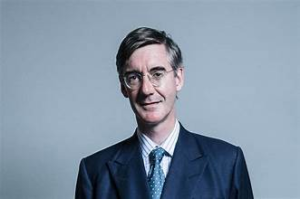
Jacob William Rees-Mogg was born on May 24th, 1969 to William and Gillian Rees-Mogg in London, the fourth of their five children. He was primarily raised by Veronica Cook, the family’s nanny. She looked after him and later his children over a period of more than fifty years.
When Jacob was nine, the family moved into The Old Rectory, a Georgian period house in the Somerset village of Hinton Blewett between Bath and Bristol. That was to be his home for the next twenty years.
Jacob attended Eton and Oxford where he was contemporary with the likes of David Cameron and Boris Johnson who would both rise in English politics. However, after Oxford Jacob made a detour to the financial world. He helped found a fund management company, Somerset Capital, and this made him wealthy.
He first tried to enter Parliament in 1997, but failed. With his upper class background, he was described as being “so posh, it was as if he had been transported in time from a previous century.” He caused some bewilderment among locals by canvassing the area with his family’s nanny and touring the constituency in a Bentley.
He was finally elected as the MP for NE Somerset in 2010. During his time in Parliament, he became a leader of the curiously-named European Research Group, curious because it was anti-Europe and campaigned for Brexit. In 2019 he was appointed Leader of the House of Commons by Boris Johnson. He resigned from the Cabinet in 2022 on St. Crispin’s Day, according to his handwritten note.
From Rees to Rees-Mogg
Jacob’s paternal line began as Rees and came from Wales. John Rees was born at Wick in Glamorgan in 1772. Having been ordained in the Anglican church, he moved to England and was the Prebendary of Tytherington, an office of the Collegiate Church of Heytesbury in Wiltshire. He also served as chaplain to the Duke of Cumberland. In 1805 he married Mary Mogg Wooldrige in Somerset.
So why Rees-Mogg? Why did the Rev. John Rees take at the time of his marriage the additional name of Mogg?
In short, Mogg had a coat of arms and counted for more in Somerset. John Mogg was the Sheriff of Somerset in 1703; while his son Richard acquired the manor of Cholwell some ten miles south of Bristol in 1716.
Lacking male descendants after the death of Richard’s son John, the Mogg inheritance passed to John’s daughter Mary. She married William Wooldrige in 1772. On her death, it then passed to her daughter Mary Mogg Wooldrige who married the Rev. John Rees in 1805. And, in accordance with John Mogg’s will, the Rev. John Rees should assume by royal licence the additional surname and arms of Mogg.
The Rees-Moggs in Somerset
The Rees-Moggs were country gentry at Cholwell House and remained in place there until the time of the Second World War. William, the son of the Rev. John Rees-Mogg and a lawyer by profession, completed the construction of the present building in 1854, at which time the old house was pulled down.
William’s son William Wooldridge was one of the two principal landowners in the vicinity of Camely in NE Somerset. His son Fletcher served in World War One and was a wealthy farmer. He was appointed the High Sheriff of Somerset in 1945.
These Rees-Moggs married some interesting women:
- Fletcher Rees-Mogg married Beatrice Warren in 1920. She was an Irish-American Shakespearian actress who hailed from Mamaroneck, New York. She had come to England to join the Old Vic company but married Fletcher instead.
- their son William married Gillian Shakespeare Morris, his secretary at the Sunday Times, in 1962. The Shakespeare name here came from her mother who was a Shakespeare. Her father Thomas, born in Hackney and a lorry driver, had risen to be the mayor of St. Pancras by the time of their marriage.
- and their son Jacob married Helena de Chair frrom the gentry de Chair family in 2007. Her father Somerset de Chair was an author and poet. He was known for his extravagant taste and lived in a number of large country houses. Jacob was said to have proposed in one of these houses under one of its six Van Dykes.
It was Beatrice Warren who had a strong Catholic faith which she brought to the Rees-Mogg family.
Jacob’s father William Rees-Mogg was the first in the family to establish a national profile. Born in 1928, he had grown up at the Cholwell House estate.
After the war, he tried to get into Parliament but failed in both attempts. He became a journalist with the Financial Times instead. He rose in the 1960’s to be Deputy Editor of the Sunday Times and, from 1967 to 1981, Editor (pre-Murdoch) of The Times.
This placed him amongst “the great and the good” of the country. He served as the Chairman of the Arts Council and Vice-Chairman of the BBC’s Board of Governors. He was made a life peer in 1988.
Jacob Rees-Mogg’s Family Line
- John Rees (1737-1806) of Wick in Glamorgan m. Catherine Leyton
- – John Rees (1772-1835)
- Rev. John Rees/Rees-Mogg m. Mary Mogg Wooldrige (1774-1846) in Somerset in 1805
- – William Rees-Mogg (1815-1909)
- – Mary Rees-Mogg (1815-1905)
- William Rees-Mogg m. Anne James (1813-1892) in Salisbury in 1847
- – William Wooldridge Rees-Mogg (1848-1913)
- – Rev. Henry Rees-Mogg (1851-1940) m. Charlotte Newton
- William Rees-Mogg m. Emily Savory (1860-1938) in 1884
- – Catherine Rees-Mogg (1885-1958)
- – Edmund Fletcher Rees-Mogg (1889-1962)
- Fletcher Rees-Mogg m. Beatrice Warren (1892-1978) in 1920
- – Elizabeth Rees-Mogg (1921-2013) m. Peter Bruegger
- – William Rees-Mogg (1928-2012)
- William Rees-Mogg m. Gillian Shakespeare Morris (b. 1939) in 1962
- – Emma Rees-Mogg (b. 1962) m. David Craigie
- – Charlotte Rees-Mogg (b. 1964)
- – Thomas Rees-Mogg (b. 1966) m. Modwenna Northcote
- – Jacob Rees-Mogg (b. 1969)
- – Annunziata Rees-Mogg (b. 1979) m. Matthew Glanville
- Jacob Rees-Mogg m. Helena de Chair (b. 1977) in Canterbury in 2007
- – Peter Rees-Mogg (b. 2007)
- – Mary Rees-Mogg (b. 2008)
- – Thomas Rees-Mogg (b. 2010)
- – Anslem Rees-Mogg (b. 2012)
- – Alfred Rees-Mogg (b. 2016)
- – Sixtus Rees-Mogg (b. 2017)
Click here for return to front page
Written by Colin Shelley